What You'll Learn
Municipal winter maintenance is about more than clearing roads. Public works and facility teams are also responsible for keeping sidewalks, building entrances, curb ramps, steps, handicap parking spaces, plazas, and other pedestrian areas accessible during changing winter conditions.
Those areas create a different set of challenges than streets and parking lots. They’re often close to doors, landscaping, metal frames, finished flooring, and heavily traveled public spaces. They may also need attention before municipal offices, libraries, police stations, fire departments, public works buildings, and community centers open for the day.
That’s why liquid ice melt should be viewed as one tool within a broader winter maintenance plan; not necessarily as a replacement for every granular product, plow, shovel, or mechanical snow-removal method.
Where Ice Melt Fits Municipal
Start With a Clear Level of Service
A practical municipal plan begins by defining priorities and expected conditions. To define these items, start by answering these questions.
- Which buildings must remain accessible around the clock?
- Which entrances open first?
- Which walkways serve employees, emergency personnel, older residents, or people with mobility limitations?
Federal Highway Administration guidance identifies snow and ice as common seasonal maintenance concerns for sidewalks, curb ramps, crosswalks, and other pedestrian facilities. Maintaining those areas supports both safety and mobility, particularly when winter weather can create barriers for pedestrians.
Once a municipality establishes its priorities, each property can be divided into treatment zones. Large parking areas and secondary walkways may continue to use traditional products and equipment. High-visibility or high-traffic spaces may benefit from a more specialized liquid treatment.
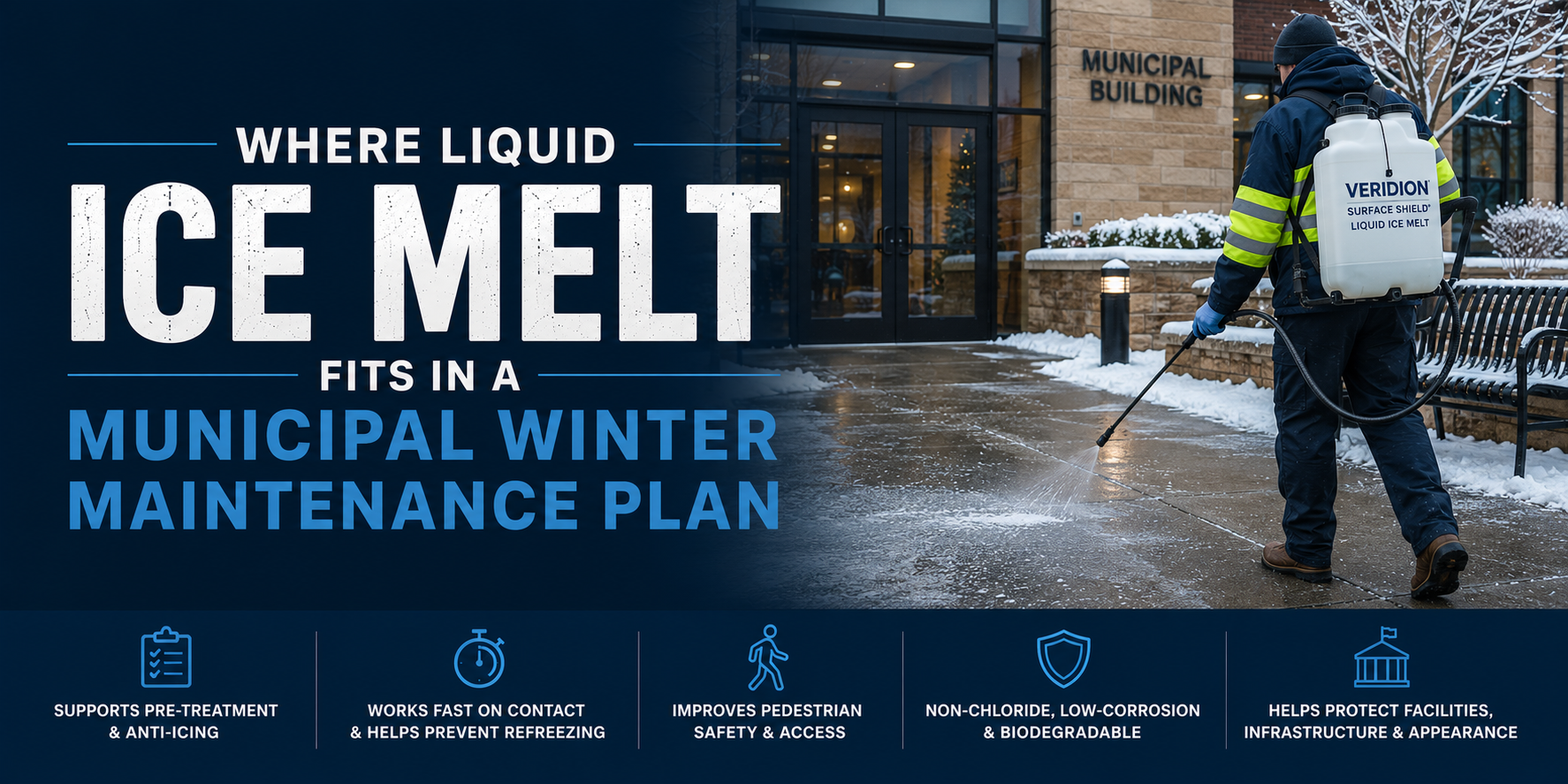
This is where Veridion Surface Shield® liquid ice melt can become particularly useful.
Use Veridion in Sensitive Areas with High Foot Traffic
Veridion is a non-chloride liquid deicer made from an aqueous potassium acetate solution. It’s designed for anti-icing, deicing, and prewetting applications, giving municipal teams several ways to incorporate it into winter operations.
For facility-focused applications, it’s especially well-suited for:
- Main building entrances
- Public sidewalks and pedestrian approaches
- Steps, ramps, handicap parking spaces, and loading areas
- Areas around metal doors and frames
- Entryways where material may otherwise be tracked indoors
- Locations near landscaping or sensitive infrastructure
- High-priority areas that require rapid treatment
Unlike granular ice melt, the liquid formulation begins working on contact and can be sprayed in a thin, even layer. Veridion is also non-tracking, contains no dyes, and doesn’t leave the granular buildup that can collect around thresholds and doorjambs. The Cope Company Salt also positions it as a low-corrosion option that won’t damage metal door frames when used as directed.
For municipal buildings where appearance matters and foot traffic moves directly from the sidewalk into finished interior spaces, those qualities can help reduce residue, cleanup demands, and the unprofessional look of scattered salt around entrances.
Add Pre-Treatment to the Plan
One of the most valuable ways to use liquid ice melt is before precipitation begins.
Anti-icing is the practice of applying a freezing-point depressant before or near the beginning of a storm to prevent snow and ice from bonding tightly to pavement. Federal winter maintenance guidance recognizes anti-icing to maintain better surface conditions while improving the efficiency of snow and ice removal.
Municipal teams can apply Veridion to designated walkways, ramps, and entry areas before a forecasted event. By helping prevent adhesion, it can make later shoveling, scraping, or mechanical removal easier.
Pre-treatment can be especially valuable before overnight storms. Crews may be able to treat priority entrances before leaving for the day, giving the product time to work before employees and the public arrive the next morning.
Veridion can also be used after snow or ice has formed. The Cope Company Salt’s product begins melting ice in under 30 seconds and helps prevent refreezing down to -25°F.
Support Mechanical Removal Rather Than Replace It
No ice melt product eliminates the need for good operational practices. Municipal teams should still monitor forecasts and pavement conditions, remove accumulated snow promptly, inspect treated areas, and reapply products when conditions require it.
The best results often come from combining methods. A typical sequence might include pre-treating priority pedestrian areas, removing snow mechanically during or after the event, and applying a limited post-treatment to remaining packed snow or ice.
Veridion can help break the bond between ice and pavement before crews shovel or scrape the surface. That means it fits naturally into a plan built around mechanical removal instead of encouraging teams to overapply chemical products and wait for them to do all the work.
This targeted approach also makes sense from an environmental and infrastructure perspective. The EPA notes that heavy road-salt use can affect drinking water, wildlife, vegetation, vehicles, public property, and infrastructure. It recommends better management practices and alternatives that help facilities maintain safety while limiting unnecessary salt use.
Because Veridion contains no sodium or chlorides and readily biodegrades at low temperatures, it gives municipalities another option for locations where reducing chloride exposure is a priority.
Train Crews on Coverage and Application
You have a range of ice melt product options, but liquid products work best when crews understand that more isn’t always better.
Veridion requires no mixing and should be applied with a clean polyethylene sprayer. Cope recommends applying a thin, even layer and avoiding overapplication. One gallon typically covers approximately 1,000 to 1,500 square feet, depending on the surface and conditions. The company also states that half a gallon can cover approximately the same area as 50 pounds of traditional granular ice melt.
Municipalities can improve consistency by identifying approved application rates, marking treatment zones, assigning specific equipment, and documenting when and where the product was used.
Build a More Flexible Winter Response
Veridion doesn’t need to replace every ice melt product in a municipal inventory. Its greatest value may come from using it strategically in areas where cleanliness, corrosion, tracking, pedestrian safety, and surface protection matter most.
By adding Veridion to a winter maintenance plan, municipal facility teams gain a product that can be used before a storm, after ice forms, or alongside mechanical removal. That creates a more flexible response; one that helps keep public walkways open while protecting the appearance and condition of important municipal facilities.
For help determining where Veridion fits within your current winter maintenance program, contact The Cope Company Salt to discuss your facilities, treatment areas, and product requirements.